The construction industry is undergoing a massive transformation—and precast concrete is at the heart of this change. With the need for faster, safer, and more reliable construction, precast technology has emerged as a preferred solution for builders, developers, and architects.
But how exactly does precast technology work?
What happens inside a precast factory?
How does the element travel from the casting yard to the site?
And how do these giant slabs, walls, and beams get installed so accurately?
This blog breaks down the entire precast process from start to finish, giving you a clear understanding of how this modern construction method delivers speed, quality, and precision.
What Is Precast Technology? (Quick Recap)
Precast technology involves manufacturing concrete elements in a factory, curing them under controlled conditions, and then transporting them to the site for installation.
This eliminates delays caused by weather, manual labour, and curing time—leading to 30–50% faster project execution.
Step-by-Step Process: From Design to Installation
Below is the complete workflow of precast construction:
1. Project Planning & Structural Design
Every precast project begins with detailed planning.
✔ BIM & 3D Modelling
Engineers use BIM (Building Information Modelling) to create a virtual 3D model of the entire building.
They design every element as a part of a giant puzzle that will be assembled on-site.
This ensures:
- High precision
- No clashes
- No measurement errors
- Perfect alignment
✔ Production Drawings
Each precast element gets its own shop drawing specifying:
- Dimensions
- Reinforcement details
- Joint locations
- Lifting points
- Grouting areas
This stage is the foundation of accuracy.
2. Rebar Cutting & Cage Preparation
The structural strength of precast comes from its reinforcement steel.
In the factory:
- Steel bars are cut, bent, and welded using automated machines.
- Rebar cages are created according to the drawings.
- These cages ensure strength, stiffness, and durability.
Quality checks are done here to ensure proper spacing and alignment.
3. Mould Preparation
Precast moulds are made from:
- Steel
- Aluminium
- Rubber (for decorative elements)
- Timber (for temporary use)
The mould is:
✔ Cleaned
✔ Polished
✔ Applied with release agent
✔ Checked for dimensions
This ensures a smooth finish and easy demoulding.
4. Placing Reinforcement into Moulds
The rebar cage is lifted and placed into the mould.
At this stage, engineers check:
- Cover blocks
- Alignment
- Lifting hooks
- Inserts
- Conduits (if electrical or plumbing is embedded)
This ensures every element matches the design perfectly.
5. Concrete Mixing & Pouring
Precast concrete requires high-quality controlled mix.
In the batching plant:
- Cement
- Sand
- Aggregates
- Admixtures
- Water
are mixed with precision.
Concrete is poured into the moulds using pumps or buckets.
✔ Compaction
Special vibrators remove air pockets to achieve dense and crack-resistant concrete.
6. Curing (Steam or Controlled Curing)
One of the biggest advantages of precast is controlled curing.
Instead of waiting 14–28 days (like traditional site curing), precast uses:
- Steam curing chambers
- Temperature-controlled environments
This achieves:
- Faster strength gain
- Higher quality
- Better durability
By the next day, some elements reach 70–80% strength.
7. Demoulding & Quality Checks
Once cured, the precast element is removed from the mould.
Each unit undergoes strict checks for:
- Dimensions
- Surface finish
- Strength
- Alignment
- Reinforcement exposure
- Cracks
Only approved units proceed to storage.
This ensures consistent high quality.
8. Storage in the Casting Yard
Precast elements are stored carefully in the yard using:
- Racks
- Supports
- Wooden blocks
They are handled using EOT cranes or gantry cranes to avoid damage.
Storage is planned based on:
- Installation sequence
- Transportation logistics
- Safety requirements
9. Transportation to Site
Transporting precast requires proper planning.
Elements are transported using:
- Flatbed trucks
- Trailers
- Specialized carriers
To ensure safety:
✔ Edges are protected
✔ Units are tied down securely
✔ Proper route planning is done
Transportation is usually done during off-peak hours.
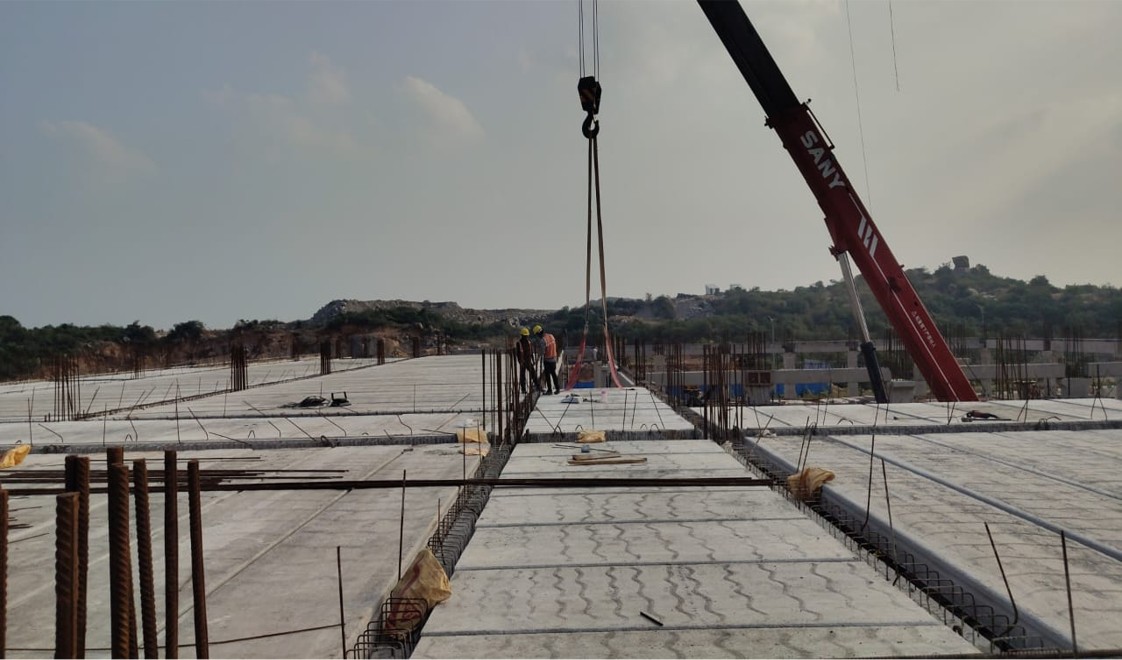
10. Installation at Site
Here is where precast shines—installation is extremely fast.
✔ Step 1: Crane Lifting
Cranes lift the elements using pre-installed lifting hooks.
✔ Step 2: Positioning
Elements are guided to the desired position using alignment bars.
✔ Step 3: Connection
Elements are connected using:
- Grout
- Bolts
- Weld plates
- Sleeves
- Post-tensioning
✔ Step 4: Grouting
High-strength grout fills gaps to ensure:
- Load transfer
- Stability
- Water-tightness
Within hours, a building begins to take shape.
11. Final Finishing & Sealing
Once installed:
- Joints are sealed
- Finishing is applied
- MEP integration is checked
- Quality inspection is done
Precast surfaces are smoother, requiring minimal plaster.
Why This Process Works Better Than Traditional Construction
✔ Faster by 30–50%
Parallel activities drastically cut timelines.
✔ Higher Quality
Factory-controlled conditions eliminate errors and inconsistencies.
✔ Stronger Structures
High-density concrete improves strength and lifespan.
✔ Less Labour
Automation reduces dependence on skilled labour.
✔ Weather-Proof Production
Rain or heat doesn’t delay factory operations.
The Environmental Advantage
Precast is eco-friendly because:
- Less material waste
- Lower carbon footprint
- Controlled water usage
- Recyclable moulds and materials
This makes it ideal for green construction projects.
Where Precast Technology Is Used
Precast is used in:
- Residential buildings
- High-rise apartments
- Villas and row houses
- Commercial buildings
- Industrial sheds
- Metro stations
- Bridges & flyovers
- Water tanks
- Compound walls
It fits almost every type of construction.
Final Thoughts: Precast Is the Smartest Way to Build Today
Precast technology combines:
- Speed
- Strength
- Precision
- Safety
- Predictability
As construction demands rise and labour shortages increase, precast is set to become the dominant construction method of the next decade.