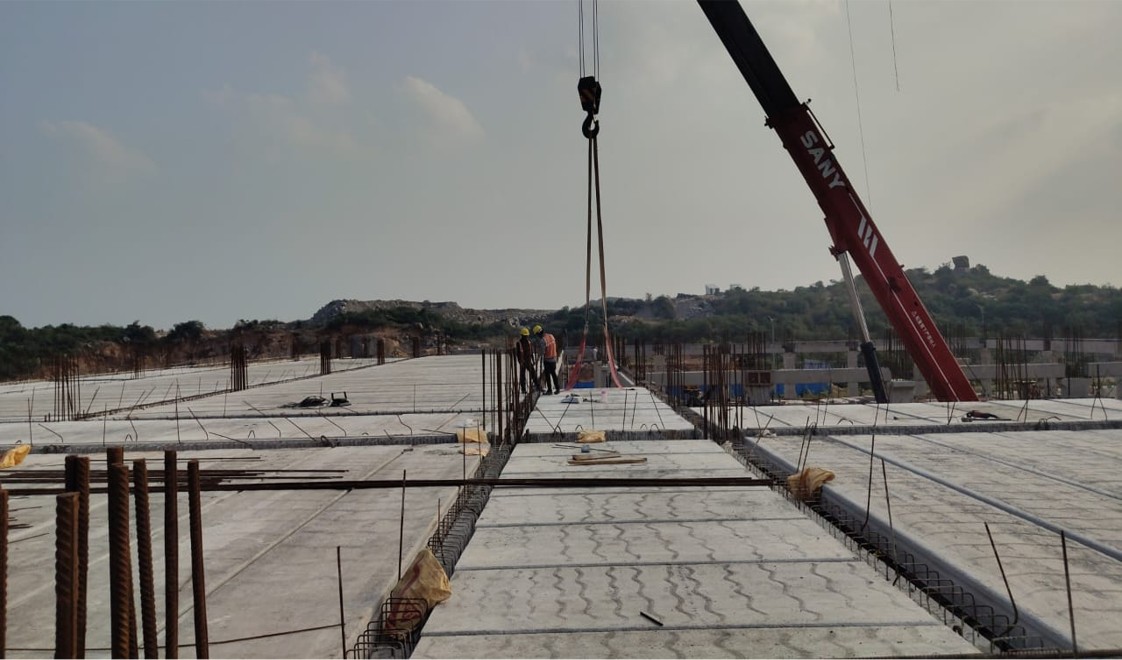
Construction is one of the most hazardous industries in the world. Every year, thousands of workers face injuries due to falls, collapsing formwork, unsafe lifting practices, and exposure to dust or heavy equipment. As project timelines shrink and labour shortages increase, safety risks only multiply.
This is where precast concrete technology brings a revolutionary shift.
By shifting 70–80% of construction activities from chaotic job sites to controlled factory environments, precast drastically reduces the risk exposure of workers. In fact, precast projects are consistently proven to be safer, cleaner, and more predictable than conventional methods.
This blog explores how precast technology significantly enhances construction safety and why safety-focused developers are rapidly embracing it.
1. The Safety Challenges of Traditional Construction
Traditional cast-in-situ construction involves:
- Scaffolding and shuttering
- Manual rebar tying
- Concrete pouring at height
- Heavy lifting
- Congested sites
- Dust, noise, and debris
- Weather interruptions
- Unskilled labour handling complex tasks
These variables create a high-risk environment where even a small mistake can lead to accidents.
In contrast, precast removes most of these hazardous activities from the site altogether.
2. How Precast Reduces Risks at Every Stage
✔ Minimum Work at Heights
In conventional construction, workers stand on scaffolding to tie rebar, install formwork, or pour slabs.
In precast, these components are manufactured on ground-level beds inside a factory.
Result → 90% reduction in height-related accidents.
✔ Elimination of Shuttering & Formwork Hazards
Formwork-related failures are among the top causes of site accidents.
Since precast uses reusable factory moulds, workers avoid:
- Formwork collapse
- Faulty props
- Alignment issues
- Improper curing leading to structural failure
✔ Better Control Over Rebar & Concrete Handling
Manual rebar tying and concrete pouring involve sharp tools, heavy lifting, and constant movement.
Precast replaces these with:
- Automated rebar machines
- Controlled concrete batching
- Mechanical placement in moulds
This reduces:
- Cuts
- Strains
- Chemical exposure
- Manual handling injuries
✔ Reduced Site Congestion
A major cause of accidents is overcrowding of workers, equipment, and materials.
Precast reduces site labour by 40–60%, creating more open and safe working zones.
✔ Improved Structural Stability During Construction
Traditional buildings rely on temporary supports until the concrete gains strength.
Precast elements arrive with full strength, eliminating the risk of:
- Early-stage collapse
- Weak curing
- Improper compaction
✔ Controlled Factory Environment
Inside a precast factory:
- Machines handle heavy lifting
- Surfaces are stable
- Lighting is consistent
- Temperature is controlled
- Workflows are standardized
This drastically minimizes unpredictable risks.
3. Enhanced Lifting Safety Through Precast
One of the biggest risks in construction is moving large or heavy loads.
Precast systems improve this through:
Built-in Lifting Anchors
Every precast element has engineered lifting points calibrated for safety.
Crane Movement Planning
Lifts are pre-planned with load charts and weight mapping.
Repeatable Lifting Procedures
Since panels are consistent, crane operators follow the same safe sequence each time.
Fewer Unpredictable Loads
On-site concrete varies in weight due to moisture, mix, and human error — precast eliminates this.
4. Weather-Proof Construction Improves Safety
Weather is a major hazard in traditional construction:
- Rain creates slippery surfaces
- Wind destabilizes scaffolding
- Heat stress affects workers
- Storms disrupt curing
- Dust increases risk of respiratory issues
Precast greatly reduces dependency on weather since most work is done indoors.
On-site assembly is quick, predictable, and largely unaffected by climate fluctuations.
5. Safety Through Standardization
Precast factories follow strict manufacturing protocols:
- Quality checks at every stage
- Strict curing procedures
- Machine-controlled precision
- Standard operating processes
- Testing for each batch
This consistency improves not just quality—but also worker safety.
6. Environmental Safety & Dust Reduction
Traditional construction exposes workers to:
- Cement dust
- Silica dust
- Noise pollution
- Debris
- Chemical hazards
Precast minimizes these by:
- Using enclosed batching systems
- Automated pouring
- Cleaner, less noisy operation
- Reduced demolition of formwork
This creates a healthier environment for both workers and nearby residents.
7. Faster Construction = Shorter Risk Exposure
The faster a project finishes, the shorter the risk period.
Precast reduces project timelines by 30%–60%, which means:
- Fewer workdays = fewer chances of accidents
- Lower probability of weather disruptions
- Reduced machinery exposure
- Less fatigue and labour turnover
Shorter construction durations directly translate into higher overall safety.
8. Case Studies: How Precast Increased Safety
Metro Rail Projects
Using precast segments eliminated dangerous on-site concreting at heights.
High-Rise Residential Projects
Precast walls and slabs allowed faster floor cycles—reducing scaffolding duration.
Schools & Hospitals
Cleaner environments reduced exposure to dust and noise, essential for sensitive zones.
9. Why Developers Prefer Precast for Safety-Focused Projects
Developers increasingly choose precast because it ensures:
- Better worker protection
- Reduced liability and compliance issues
- Fewer delays from safety-related stoppages
- Improved brand reputation
- Stronger chances of getting certifications (IGBC, GRIHA, LEED)
- Compliance with labour and safety laws
Safety is not just a moral responsibility—it is a business advantage.
Conclusion
Precast concrete is not simply a technology—it is a safer way to build.
By reducing hazardous tasks, eliminating risky site practices, and shifting work to controlled factory environments, precast ensures:
- Safer workers
- Safer buildings
- Safer cities
As India’s construction sector evolves, safety will move from being a compliance requirement to a strategic priority. Precast technology is leading this transformation.