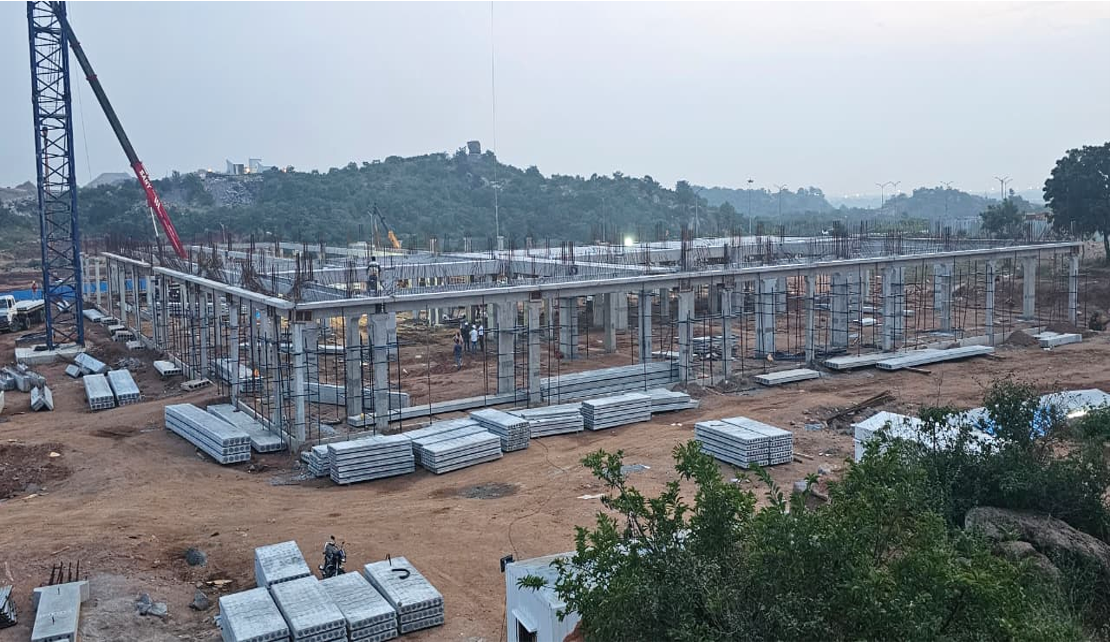
India is entering a new era of rapid urban growth. Cities are expanding, infrastructure demand is rising, and developers are under pressure to deliver large-scale projects faster than ever—without compromising quality. Traditional construction methods are struggling to keep pace.
This is where precast technology has emerged as a game-changer.
By shifting construction from messy, labour-intensive sites to controlled factory environments, precast allows builders to construct stronger, faster, and more cost-efficient structures.
In this blog, we explore why precast technology is becoming the future of Indian construction and why developers, contractors, and policymakers are rapidly embracing it.
1. The Growing Need for Faster Construction in India
India’s infrastructure demand is enormous:
- Urban population is expected to reach 675 million by 2035
- Housing shortage stands at over 18 million units
- Government targets 100 smart cities
- Massive push for industrial parks, warehouses, data centers, metros, highways
Traditional construction methods, which depend heavily on manual labour and on-site curing, are too slow to match this pace.
This gap has created a massive opportunity for precast.
2. What Makes Precast So Powerful?
Precast is the process of casting structural components—walls, slabs, beams, columns, staircases—in a factory and assembling them like Lego blocks on site.
Here’s why the system is so effective:
✔ Fast Construction
Precast reduces construction time by 30%–60%, depending on project scale.
✔ Superior Quality Control
Factory production ensures uniformity, precision, and fewer defects.
✔ Reduced Labour Dependency
Manual labour requirements drop by nearly 40%, helping counter India’s skilled labour shortages.
✔ Safer Work Environment
Most work shifts to a controlled plant, reducing on-site accidents.
✔ Sustainable & Eco-Friendly
- Less material wastage
- Optimized use of cement
- Lower carbon emissions
- Reusable moulds
3. Applications of Precast in Indian Construction
Precast is being used across a wide range of sectors:
Residential Buildings
High-rise apartments, gated communities, and affordable housing.
Commercial & Office Complexes
Faster construction, better acoustics, and reduced maintenance.
Industrial Buildings
Precast columns, beams, and wall panels speed up factory construction.
Warehouses
Long-span precast systems reduce steel usage and increase floor space.
Infrastructure
Bridges, metro rails, flyovers, tunnels, railway platforms, and retaining walls.
Public Buildings
Hospitals, hostels, schools—where speed and affordability matter most.
India is already seeing massive adoption in cities like Bangalore, Hyderabad, Chennai, Pune, Mumbai, and Ahmedabad.
4. Cost Efficiency: A Major Indian Advantage
While precast may require higher initial investment, it significantly reduces long-term costs.
Where developers save money:
- Reduced labour
- Lower wastage
- Faster project delivery → earlier sales
- Better design accuracy
- Reduced rework
- Shorter loan cycles
- Optimized material usage
Many developers report 8%–15% cost savings over the project lifecycle.
5. Why Precast Is the Future: Key Drivers in India
1. Labour Shortage & Rising Wages
India’s construction labour force is shrinking due to:
- Migration
- Alternative employment opportunities
- Better education and career shifts
Precast reduces dependency on site labour.
2. Speed = More ROI
Time saved → quicker handovers → faster revenue generation.
Builders can complete two projects in the time of one.
3. Government Push for Modern Construction
Schemes like:
- PMAY
- Smart Cities
- Housing for All
- Bharatmala & Sagarmala
- Industrial Corridors
These demand rapid, scalable construction—perfect for precast.
4. Sustainability Mandates
Government is tightening sustainability and waste management rules.
Precast aligns perfectly with green building codes.
5. Quality Conscious Buyers
Modern homebuyers seek:
- Crack-free walls
- Sound insulation
- Better finish
- Long-lasting structures
Precast delivers all of these.
6. How Precast Overcomes Traditional Construction Challenges
Traditional construction struggles with:
| Challenge | Precast Solution |
| Delays due to weather | Factory manufacturing unaffected |
| Material wastage | Controlled batching, reuse of moulds |
| Poor finish quality | Automated production lines |
| On-site congestion | Plug-and-play assembly |
| Skilled labour shortage | Mechanical production |
| Structural inconsistencies | Machine-controlled precision |
Precast is not just faster—it is fundamentally better.
7. Myths That Stop Developers From Adopting Precast
❌ “It’s too expensive”
Truth: Higher initial investment, but lower total project cost.
❌ “It limits design flexibility”
Truth: Complex curves, textures, and architectural features are possible.
❌ “It’s only for large projects”
Truth: Even villas and mid-rise buildings can benefit.
❌ “Repairs are difficult”
Truth: Modern epoxy and bonding agents make maintenance simple.
8. Success Stories From India
- L&T has completed thousands of apartment units using precast.
- Bangalore & Hyderabad are leading in precast adoption for IT parks and premium residential blocks.
- Affordable housing projects across Telangana, Maharashtra, and Tamil Nadu are using precast to deliver 10,000+ units rapidly.
- Metro rail infrastructure now uses precast for piers, girders, and tunnel rings.
India is no longer exploring precast—it is implementing it at scale.
Final Conclusion
Precast is not a trend.
It is the construction method that will define India’s next decade.
Developers adopting precast will experience:
- Faster timelines
- Higher quality
- Better margins
- Lower risk
- Stronger structures
- Increased sustainability
Those who delay adoption risk being outpaced by faster, more efficient competitors.